
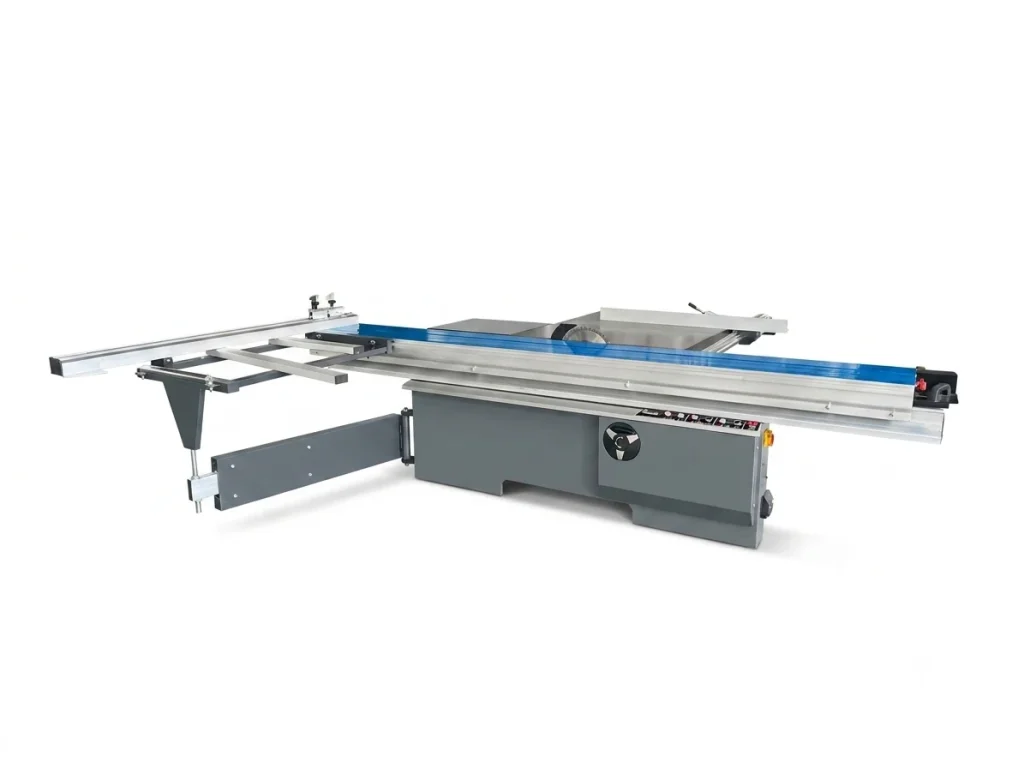
A sliding table saw is often the first major cutting machine in a furniture workshop. The correct configuration depends on the sheet material, part sizes, cut quality, angles and daily handling pattern. A useful quotation therefore begins with the work, not with a single motor-power or table-length figure.
Define the workpiece range
Provide the largest sheet, smallest finished part, maximum cut thickness and typical material. Identify coated boards, solid wood, plastics or composite panels separately because blade choice, scoring and feed technique may differ. State how often the operator cuts full sheets compared with smaller components.
Describe the required cuts
List straight sizing, repeated rip cuts, crosscuts and angle or bevel work. For angled cuts, confirm the required range and how frequently the setting changes. If dimensional tolerance or visible-edge quality is critical, provide a drawing or an accepted sample rather than using a general phrase such as “high precision.”
Main blade, scoring and controls
Coated panels may require a correctly aligned scoring process to reduce chipping on the lower surface. Blade selection, blade condition, material support and operator setup all influence the result. Ask how the main and scoring arrangements are adjusted and maintained.
Digital readouts or powered adjustments can support repeatability, but the appropriate control level depends on batch size, change frequency and operator workflow. Compare the complete setup procedure, not only the number of electronic functions.
| Selection area | Questions to answer |
|---|---|
| Capacity | What are the largest sheet and maximum thickness? |
| Quality | Which surfaces are visible, and what sample is acceptable? |
| Angles | What tilt or miter range is required, and how often does it change? |
| Workflow | How are sheets loaded, supported, labeled and removed? |
| Utilities | What voltage, frequency and dust extraction are available? |
Plan the real installation area
The machine footprint is only part of the space requirement. Add infeed and outfeed length, room to rotate the largest panel, operator position, dust ducting, electrical access and maintenance clearance. Also check doors, corridors and unloading access before shipment.
Dust extraction and workshop conditions
Confirm dust-port sizes and the extraction requirement with the proposed blade and material range. The dust collector and duct network should be reviewed together. Local rules for electrical installation, guarding and combustible dust must be evaluated by qualified local professionals.
Prepare a fair comparison
Send every supplier the same panel range, cutting operations, output pattern, utilities and acceptance sample. Then compare included blades and accessories, setup method, documentation, packing, spare parts, commissioning support and warranty scope alongside price.
Information to send with an RFQ
- Material types and representative sheet sizes
- Maximum thickness and minimum finished part
- Required straight, angled and bevel cuts
- Surface and edge-quality expectations
- Typical shift volume and batch pattern
- Workshop drawing and material-flow direction
- Voltage, frequency and dust-extraction details
- Destination and unloading limitations
See the sliding table saw selection guide and primary models, or send your cutting requirements to JDRG for a configuration discussion.